Raspberry Pi in Manufacturing and Automation: What Founders and Engineers Need to Know
Discover how Raspberry Pi can transform manufacturing and automation for founders and engineers, offering cost-effective solutions for industrial

Raspberry Pi began as an educational tool designed to make computing accessible to students, but the trajectory of the platform since its introduction has taken it well beyond the classroom and into factories, monitoring stations, and industrial control systems around the world. For founders building hardware products or engineers designing automation systems on constrained budgets, understanding what Raspberry Pi can and cannot do in an industrial context is genuinely useful knowledge, not just a hobbyist curiosity.
A Platform With Several Distinct Product Lines
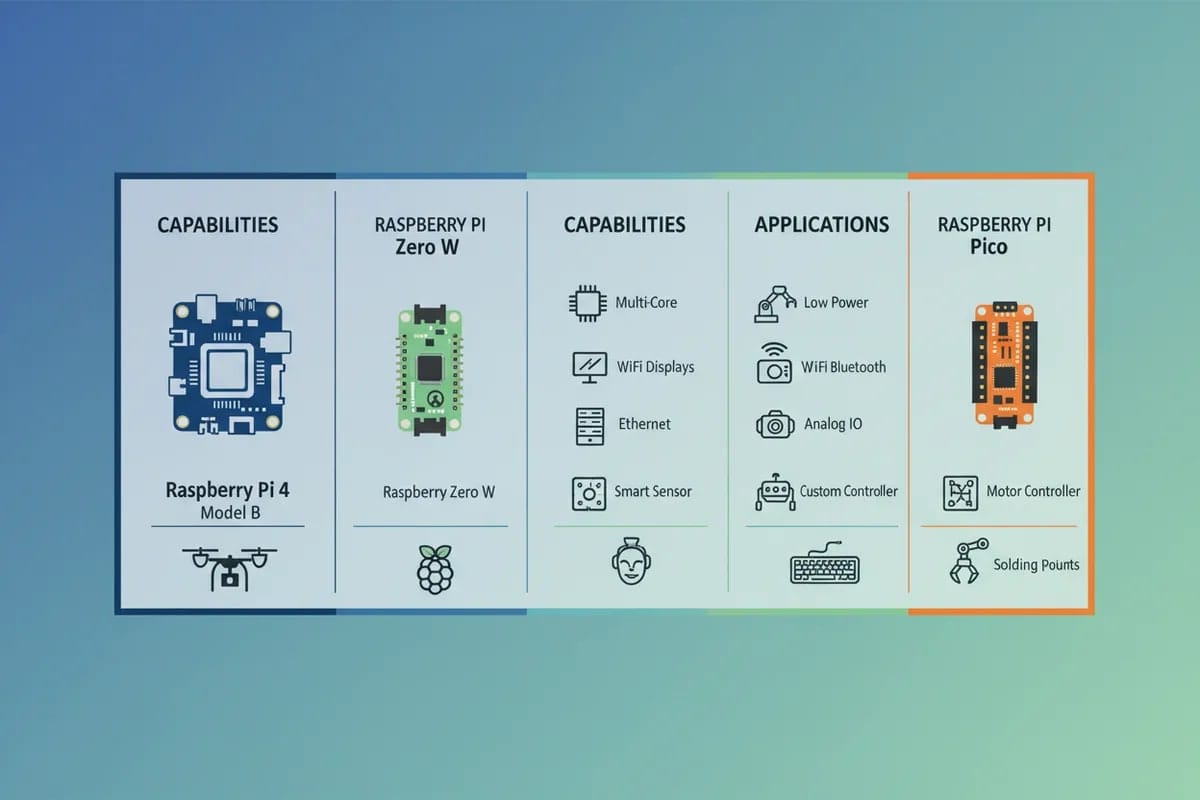
The Raspberry Pi Foundation produces four distinct series of boards, and the differences between them matter considerably when you are choosing hardware for a specific application rather than experimenting on a workbench.
The Flagship series, which includes the Raspberry Pi 4 Model B, represents the most capable end of the range and runs a full Linux operating system with support for USB 3.0, dual-display output, Gigabit Ethernet, and up to 8GB of RAM. This is the board most people picture when they think of Raspberry Pi, and it is the one most suited to applications that require a full software stack, network connectivity, and meaningful processing headroom.
The Zero series, exemplified by the Raspberry Pi Zero 2 W, trades raw capability for an extremely compact form factor and low power consumption. The Zero 2 W uses a quad-core ARM Cortex-A53 processor and includes wireless connectivity, making it a reasonable choice for embedded applications where space and power budgets are tight and the computational demands are modest.
The Compute Module series is the product line that most directly targets industrial and embedded deployments. These modules expose the core computing hardware without the standard consumer ports, allowing engineers to design custom carrier boards that integrate the module into a larger system. This approach gives product teams the flexibility to build exactly the interface they need while relying on a well-supported and well-documented compute platform at the heart of the design.
The Pico series is fundamentally different from the others because it is a microcontroller rather than a microcomputer. The Raspberry Pi Pico runs firmware directly on its RP2040 chip without an operating system, which makes it well suited to real-time control tasks, sensor interfacing, and any application where deterministic timing matters more than software flexibility.
How Raspberry Pi Compares to Arduino and Traditional PLCs
The comparison with Arduino is worth addressing directly because both platforms appear frequently in early-stage hardware development. Arduino boards are excellent for learning electronics and for simple control tasks, but they run no operating system and have limited processing power. Raspberry Pi, even in its more modest configurations, offers substantially higher processing capability and the ability to run Linux, which opens the door to networking, databases, web servers, and the full ecosystem of open-source software. For a startup building a prototype that needs to communicate with cloud infrastructure or run a local data pipeline, the difference is significant.
The comparison with traditional Programmable Logic Controllers is more nuanced and deserves honest treatment. PLCs have been the backbone of industrial automation for decades precisely because they are engineered for reliability in demanding environments, with deterministic execution, robust hardware, and long support lifecycles. A Raspberry Pi running OpenPLC software can replicate some PLC functionality at a fraction of the cost, but industry professionals who work with safety-critical processes are right to question whether a general-purpose computer running Linux is an appropriate substitute for certified industrial hardware in applications where failure could cause downtime, equipment damage, or safety incidents. The honest answer is that Raspberry Pi is not a direct replacement for a PLC in critical processes, but it is a credible and cost-effective option for a wide range of monitoring, data logging, and non-critical control applications.
Industrial Applications That Are Already Working
The most compelling evidence for Raspberry Pi's industrial viability comes from companies that have built commercial products around it rather than from theoretical capability assessments.
Sfera Labs has built a range of industrial automation servers, input/output modules, and sensor systems using Raspberry Pi technology, demonstrating that the platform can be hardened and packaged for demanding environments when the engineering work is done properly. Their products serve industrial customers who need flexibility and connectivity without the cost and rigidity of traditional industrial computing platforms.
Industrial Shields develops industrial computers powered by Raspberry Pi and reports that nearly 50 percent of their total products sold contain Raspberry Pi devices. Their customer base spans the petrochemical, metal, manufacturing, and power industries, which are not sectors known for tolerating unreliable hardware. That level of commercial adoption in genuinely demanding sectors is meaningful evidence that the platform can be made to work reliably when it is packaged and deployed thoughtfully.
Revolution Pi builds industrial computers based on Raspberry Pi Compute Modules and targets industrial IoT and automation applications specifically. Their approach of using the Compute Module as the processing core of a purpose-built industrial system is a good model for any startup that wants to leverage the Raspberry Pi ecosystem while building a product that meets the form factor and connectivity requirements of industrial customers.
Data Acquisition and Human-Machine Interfaces
Two application categories where Raspberry Pi has proven particularly useful in industrial settings are data acquisition and human-machine interfaces. For data acquisition, a Raspberry Pi can collect readings from sensors via GPIO pins, I2C, SPI, or serial interfaces, process that data locally, and transmit it to a central server or cloud platform. A published research platform for Modbus sensor data logging built on Raspberry Pi hardware had a total component cost of between €54 and €63 excluding housing, which illustrates how dramatically the economics of industrial monitoring can shift when you replace proprietary data acquisition hardware with a well-designed open platform.
For human-machine interfaces, the ability to run a full Linux operating system and support graphical display output makes Raspberry Pi a practical foundation for touchscreen control panels and status displays in manufacturing environments. Building an HMI on a Raspberry Pi rather than purchasing a dedicated industrial panel PC can reduce hardware costs substantially, and the software flexibility means the interface can be updated and modified without replacing hardware.
Challenges That Founders Should Not Ignore
The environmental limitations of standard Raspberry Pi hardware are real and should not be dismissed. Consumer-grade Raspberry Pi boards are not rated for the temperature extremes, humidity levels, vibration, or dust exposure that characterise many industrial environments. Companies like Sfera Labs and Industrial Shields have addressed this by designing appropriate enclosures and carrier boards, but a startup that drops a bare Raspberry Pi 4 into a factory floor application without considering the operating environment is likely to encounter problems.
The reliability question is also genuine. Linux is not a real-time operating system, and the Raspberry Pi's storage relies on SD cards that can fail under sustained write loads. Engineers building systems where uptime matters need to think carefully about storage strategy, power management, watchdog timers, and the overall system architecture rather than assuming the hardware will simply run indefinitely without attention.
What This Means for Founders and Engineers
As of late 2023, the majority of Raspberry Pi units sold are integrated into commercial products and services rather than used for hobbyist projects, which reflects a genuine shift in how the platform is perceived and deployed. For a startup founder evaluating hardware options for a prototype or a minimum viable product, Raspberry Pi offers a combination of processing capability, software ecosystem, community support, and cost that is difficult to match. The Compute Module series in particular provides a credible path from prototype to production by allowing a custom carrier board to be designed around a stable and well-supported compute platform.
The practical conclusion for founders is that Raspberry Pi is most valuable in applications where flexibility, connectivity, and development speed matter more than deterministic real-time performance or certification for safety-critical use. Data logging, remote monitoring, HMI development, edge computing, and industrial IoT are all areas where the platform has demonstrated genuine commercial traction. Treating it as a serious engineering tool rather than a toy, and investing in appropriate packaging and system design, is what separates the companies that have built successful industrial products on Raspberry Pi from the prototypes that never made it to production.