Edge AI in the Factory: What Jetson, Raspberry Pi, and the Next Wave of Embedded Intelligence Mean for Manufacturing Founders
Discover how Jetson and Raspberry Pi are revolutionizing manufacturing with edge AI, enabling startups to leverage advanced technology affordably.


The factory floor has always been a proving ground for new technology, and the current wave of artificial intelligence adoption is no different in that respect, except that the speed and accessibility of the tools involved are genuinely unprecedented. Where previous industrial computing revolutions required significant capital expenditure and specialist systems integrators, today a founder building a manufacturing startup can deploy meaningful machine vision, predictive maintenance, or quality inspection capability using hardware that costs less than a decent office chair. NVIDIA's Jetson platform and the Raspberry Pi ecosystem sit at the centre of this shift, and understanding what they can realistically do, and where they fit within the broader trajectory of AI adoption in manufacturing, is increasingly important for anyone building or investing in a physical production business.
The Adoption Numbers Tell a Complicated Story
Before examining the hardware, it is worth being precise about where the industry actually stands, because the headline figures can be misleading in both directions. According to a 2025 survey by Rootstock, over 77% of manufacturers have implemented some form of AI solution, up from 70% in 2023, and 82% of manufacturers plan to expand their AI budgets over the next 12 to 18 months, with 23% anticipating increases of between 26 and 50%. Those numbers suggest a sector moving with real conviction toward AI-enabled operations.
The picture in Europe is considerably more sobering. TechRadar's analysis of European factory AI adoption found that only 13.5% of EU enterprises have actually implemented AI, despite 92% recognising its importance, which is a gap large enough to suggest that recognition and implementation are separated by something more substantial than budget hesitation. The barriers most commonly cited include lack of internal expertise and the difficulty of integrating AI tools with legacy production systems that were never designed to share data with anything.
There is also a counterintuitive signal from the United States, where a US Census Bureau survey found that AI adoption among large companies actually declined from approximately 13.5% to around 12% between June and August 2025. This does not mean AI is failing in manufacturing, but it does suggest that large organisations are encountering friction in scaling pilots into production deployments, and that the enthusiasm of 2023 and 2024 is now being tested against operational reality. For founders and smaller manufacturers, this is actually useful information because it implies that the competitive advantage available to those who do implement well is not yet competed away.
What Jetson and Raspberry Pi Actually Offer
The Rootstock survey found that manufacturers are applying AI most heavily in production processes at 31%, inventory management at 28%, and customer service at 28%. The first of those categories is where embedded AI hardware like Jetson and Raspberry Pi becomes directly relevant, because production-floor AI typically needs to operate at the edge rather than in the cloud, processing sensor data and camera feeds locally with low latency and without dependence on a reliable internet connection.
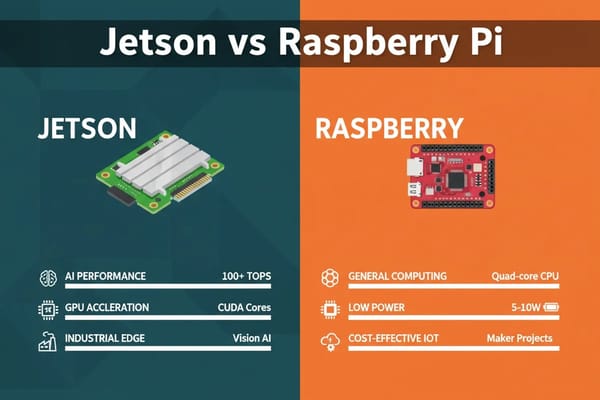
NVIDIA's Jetson family, particularly modules like the Jetson Orin series, provides GPU-accelerated inference capability in a compact, industrial-grade form factor that can run trained neural networks for tasks including visual defect detection, robotic arm guidance, and real-time process monitoring. A mid-tier Jetson Orin module delivers performance that would have required a server rack five years ago, and it can be embedded directly into a production line enclosure. The Raspberry Pi, particularly the Pi 5 and the AI Kit accessory that adds a dedicated neural processing unit, occupies a different position in the stack, offering lower raw compute but exceptional flexibility, community support, and a price point that makes experimentation genuinely low-risk for an early-stage operation.
The practical implication for a manufacturing startup is that these platforms make it possible to build a first-pass quality inspection system, a conveyor speed optimisation loop, or a predictive maintenance sensor array without commissioning a bespoke industrial computer or paying for cloud inference at scale. The software ecosystems around both platforms, including support for PyTorch, TensorFlow Lite, and NVIDIA's own DeepStream SDK for video analytics, mean that models trained in a cloud environment can be deployed to the factory floor with relatively modest integration effort.
The Broader Technology Stack These Platforms Plug Into
Jetson and Raspberry Pi do not operate in isolation, and their value increases substantially when they are understood as components within a wider architecture rather than standalone solutions. The most significant complementary technology is the industrial IoT layer, where sensors measuring temperature, vibration, pressure, current draw, and dozens of other variables feed data to edge devices that can run inference locally and pass only meaningful events or anomalies upstream to a cloud platform or ERP system.
Edge computing as a design philosophy matters here because it addresses one of the core integration challenges that European manufacturers in particular have struggled with. Rather than requiring a full rearchitecture of production systems to connect to a cloud AI platform, an edge-first approach allows a Jetson or Pi-based node to sit alongside existing machinery, read available signals, and produce outputs that can be consumed by whatever management software is already in place. This reduces the integration surface area considerably and makes it easier to demonstrate value in a contained pilot before committing to a wider rollout.
Machine learning model compression and quantisation techniques have also advanced to the point where models that previously required significant compute can run efficiently on the constrained hardware available at the edge. Techniques like knowledge distillation, where a smaller model is trained to replicate the behaviour of a larger one, and INT8 quantisation, which reduces the numerical precision of model weights to cut memory and compute requirements, are now well-supported in standard frameworks and directly relevant to anyone deploying inference on Jetson hardware.
The Skills Gap Is Real and Needs to Be Planned For
The 53% of manufacturing professionals who told Rootstock they prefer AI copilots that support human roles over fully autonomous agents are expressing something practically important rather than simply being conservative. The skills required to build, train, validate, and maintain an AI system on a production line are not yet widely distributed across the manufacturing workforce, and a system that requires a data scientist to interpret its outputs is a system that will be switched off when the data scientist leaves.
This is an argument for designing AI deployments with operational simplicity as a primary constraint from the beginning. A Raspberry Pi running a trained model that outputs a binary pass or fail signal to a light stack is something a production operator can understand and trust. A dashboard showing confidence scores across twelve defect categories requires someone with enough statistical literacy to know when the model is drifting and needs retraining. The former is deployable today in most manufacturing environments; the latter requires an investment in human capability that takes time to build.
The Realistic Forward View
The trajectory for embedded AI in manufacturing over the next three to five years is one of gradual but compounding capability improvement, driven by hardware that continues to improve in performance per watt, software tooling that continues to lower the barrier to model deployment, and an expanding body of documented implementations that reduce the perceived risk of adoption. The gap between the 92% of European manufacturers who recognise AI's importance and the 13.5% who have implemented it is not going to close overnight, but it does represent a genuine opportunity for founders who are willing to build the operational competence to deploy these systems well.
For a manufacturing startup, the most useful framing is probably not to ask whether to adopt AI but to identify the single highest-value measurement or decision point in the production process and ask whether a Jetson or Pi-based system could improve it. That specificity is what separates successful pilots from the stalled initiatives that are contributing to the adoption plateau visible in the Census Bureau data. The hardware is affordable, the software is mature enough, and the competitive landscape has not yet rewarded early movers to the degree it eventually will, which means the window for building genuine operational advantage through embedded AI is still open.