NVIDIA Jetson vs Raspberry Pi: Choosing the Right Edge Computing Platform for Manufacturing and Automation
Explore the differences between NVIDIA Jetson and Raspberry Pi for edge computing in manufacturing. Make an informed choice for your project.

Selecting the wrong compute platform at the prototype stage is one of the more expensive mistakes a hardware startup can make, not because the boards themselves cost a fortune, but because the downstream consequences of rebuilding firmware, retraining inference pipelines, or discovering that your chosen hardware cannot meet latency requirements at production volumes can consume months of engineering time. The decision between NVIDIA's Jetson platform and the Raspberry Pi is, at its core, a decision about what kind of computational work your application actually needs to perform, and the gap between these two platforms is far wider than their physical similarity as small-board computers might suggest.
What Each Platform Is Actually Built For
The Raspberry Pi is a general-purpose single-board computer that has earned its place in the prototyping ecosystem through affordability, a vast community of contributors, and a straightforward Linux-based environment that developers can be productive in within hours. The Raspberry Pi 5, the current flagship model, is priced at approximately $80 and supports up to 16GB of RAM, making it a capable machine for control logic, sensor aggregation, network communication, and lightweight data processing tasks. It draws a peak of around 10 watts, which makes it attractive for battery-powered or thermally constrained deployments.
The NVIDIA Jetson platform is purpose-built for AI inference at the edge. Every module in the Jetson lineup includes CUDA cores and Tensor cores, which are the same architectural building blocks found in NVIDIA's data centre GPUs, scaled down for embedded deployment. The entry-level Jetson Orin Nano delivers 40 TOPS (tera-operations per second) of AI performance and starts at approximately $499. The Jetson AGX Orin, the current top-of-range module, delivers up to 275 TOPS, supports up to 64GB of LPDDR5 RAM, and operates within a configurable power envelope of 15 to 60 watts depending on the workload profile. These are not incremental improvements over Raspberry Pi; they represent a fundamentally different class of hardware designed for a fundamentally different class of problem.
Specifications Side by Side
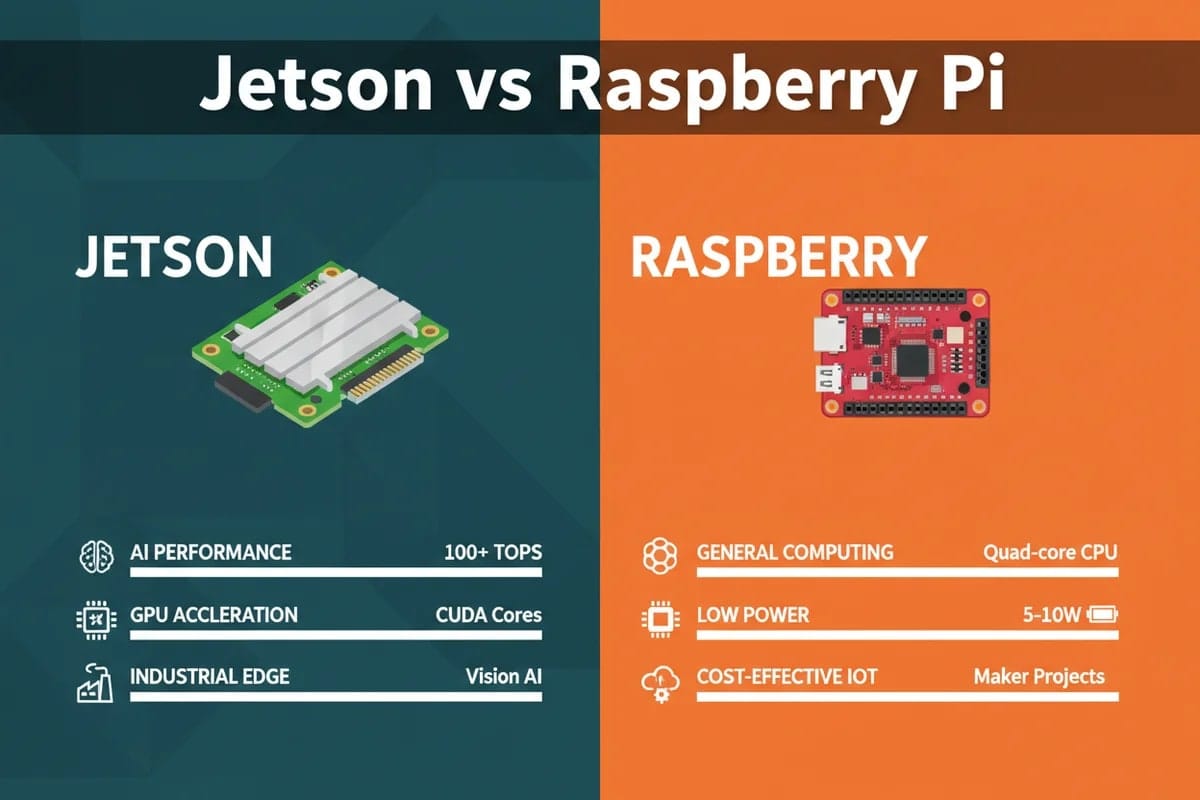
The most revealing comparison is the AI performance figure. The Raspberry Pi 5 achieves approximately 2 TOPS using its CPU alone, because it carries no dedicated AI accelerator hardware. The Jetson Orin Nano delivers 40 TOPS, and the Jetson AGX Orin reaches 275 TOPS. That is a difference of roughly 20 times at the low end of the Jetson range and more than 130 times at the high end, measured against the same Raspberry Pi baseline. For applications that require running neural networks in real time, whether for object detection, defect classification, pose estimation, or natural language processing at the edge, this gap is not a nuance; it is the entire argument.
Memory bandwidth and capacity follow a similar pattern. The Raspberry Pi 5 tops out at 16GB of shared system RAM, while the Jetson AGX Orin offers up to 64GB of high-bandwidth LPDDR5 memory, which is particularly relevant when loading large model weights or processing high-resolution video streams without offloading to cloud infrastructure. Power consumption is the one area where Raspberry Pi holds a clear advantage, drawing a maximum of around 10 watts compared to the Jetson AGX Orin's range of 15 to 60 watts, though the Jetson Orin Nano can operate at lower power settings that bring it closer to Raspberry Pi territory for less demanding inference tasks.
Ease of Use and Developer Ecosystem
Raspberry Pi runs Raspberry Pi OS, a Debian-based Linux distribution that is well documented and supported by one of the largest hobbyist and professional communities in embedded computing. The volume of tutorials, forum threads, compatible hardware accessories, and pre-built software libraries available for Raspberry Pi is genuinely difficult to overstate, and this makes it an excellent environment for rapid prototyping, proof-of-concept builds, and applications where the primary engineering challenge is integration rather than computation.
NVIDIA supports the Jetson platform with JetPack SDK, which bundles CUDA, cuDNN, TensorRT, and a suite of libraries specifically optimised for AI workloads on Jetson hardware. TensorRT in particular is significant because it allows developers to take models trained in PyTorch or TensorFlow and compile them into optimised inference engines that extract the maximum performance from the Jetson's Tensor cores. The Jetson community is smaller than Raspberry Pi's but is growing steadily, and NVIDIA's developer documentation is thorough for engineers who already have a background in machine learning infrastructure.
Cost and the Question of Justification
The cost differential between these platforms is real and should be taken seriously in any bill-of-materials analysis. A Raspberry Pi 5 at $80 versus a Jetson Orin Nano at $499 represents a roughly sixfold difference at the module level, and the Jetson AGX Orin sits at a considerably higher price point still. For a startup building a product that will be manufactured at volume, this difference compounds quickly across units, and the engineering overhead of working with a more complex platform must also be factored into the total cost of development.
The justification for Jetson's premium is straightforward when the application genuinely requires it. If your system needs to run a computer vision model at 30 frames per second on a live camera feed, classify defects on a production line in under 50 milliseconds, or coordinate the perception stack of an autonomous mobile robot, then Raspberry Pi's 2 TOPS of CPU inference is not a budget-friendly alternative; it is simply not a viable option. Conversely, if your application involves reading sensor data, managing a PLC interface, running a local web dashboard, or handling network communication between machines, then paying five or six times more for AI compute you will never use is a straightforward waste of capital.
Where Each Platform Excels in Manufacturing Contexts
NVIDIA's own documentation and partner case studies illustrate the Jetson's industrial positioning clearly. Deltia AI, for example, deployed NVIDIA Metropolis and Jetson hardware to deliver measurable assembly line efficiency improvements, using real-time computer vision to monitor operator workflows and identify process deviations without requiring cloud connectivity. This kind of application, where inference must happen locally, continuously, and with low latency, is precisely the environment Jetson was designed for. Autonomous mobile robots, quality inspection systems, predictive maintenance platforms that process vibration or thermal imaging data, and collaborative robot perception systems all fall into this category.
Raspberry Pi finds its strongest manufacturing use cases in lower-intensity roles: as a gateway device that aggregates data from sensors and forwards it to a cloud platform, as a human-machine interface running a local dashboard, as a controller for simple actuators or conveyor logic, or as a development environment for testing integration logic before deploying to more capable hardware. It is also a sensible choice for educational manufacturing labs, where the goal is teaching students to work with embedded Linux and industrial protocols rather than running production inference workloads.
Making the Decision
The choice between Jetson and Raspberry Pi is not really a close call once you have defined your application requirements with precision. If your system needs to run AI models locally and in real time, the Jetson platform is the appropriate tool and its cost premium is justified by the absence of any comparable alternative at the edge. If your system's compute requirements are primarily about connectivity, control logic, and data handling, Raspberry Pi delivers excellent value and a developer experience that will accelerate your time to prototype.
For founders building manufacturing automation products, the most important discipline is to resist the temptation to over-specify hardware in the belief that more performance is always safer, and equally to resist under-specifying in the belief that a cheaper board will always do. Map your inference requirements, measure your latency budget, and let those numbers drive the decision. The platforms are different enough that the right answer is usually clear, and getting it right at the prototype stage will save considerably more than the price difference between the two boards.